
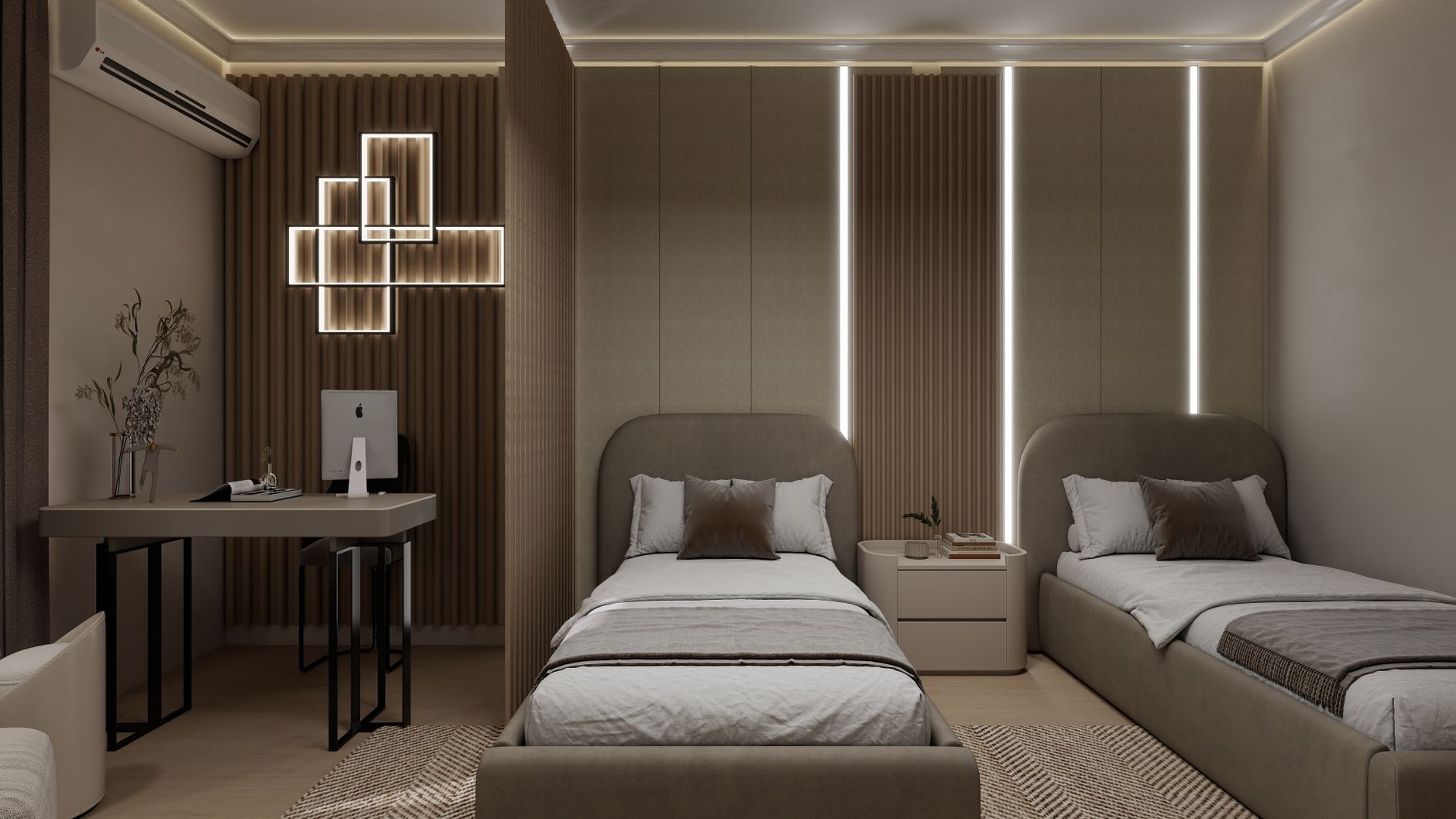
A teenager's bedroom presents a particular challenge for property photography. Unlike a kids' room, which often reads as charming, or a master bedroom, which has clear styling conventions, a teen's space tends to be highly personal, visually loud, and genuinely difficult to neutralise without stripping all the life out of it. The goal isn't to pretend the room doesn't exist. The goal is to show a bedroom that any buyer can picture in use, whether for a young adult, a second guest, or a work-from-home setup.
What makes a teen bedroom so hard to photograph
The problem isn't mess. Mess is fixable. The real issue is that teenagers fill their rooms with objects that communicate very specific identity signals: band posters, sporting trophies, gaming gear, sticker collections, fairy lights strung over every surface. Those signals connect deeply with the occupant and disconnect just as deeply with a buyer trying to picture themselves in the space. A buyer walking through a listing doesn't want to feel like they're intruding on someone's life. They want to feel potential.
There's also a lighting problem. Teen bedrooms often have blackout blinds permanently closed, lamps positioned for gaming or studying rather than ambient glow, and layers of objects that block natural light from bouncing around the room. Before any styling happens, fix the light.
Start with a full clear-out, not a tidy-up
Tidying a teen bedroom rarely works for photos. You end up with neat piles of things that still communicate "someone specific lives here." A clear-out is more effective. Remove everything from the walls. Take down all posters, pinboards, string lights, and framed photos. Clear every surface completely: desk, windowsill, bedside table, shelves. Pack personal items into boxes and move them to another room or the garage. What remains should be furniture, one or two lamps, and bedding.
Don't leave gaming chairs, monitors, or console setups in the frame unless the room is genuinely being marketed as a bedroom-with-workspace. Even then, the setup needs to be clean, minimal, and styled. A desk with one monitor, a tidy cable, and nothing else can read well. A full gaming rig with RGB lighting reads as a very specific lifestyle that not every buyer shares.
Bedding is the fastest styling lever in the room
Once the walls are clear and the surfaces are empty, bedding becomes the main visual anchor. Teen bedrooms rarely have hotel-quality linen, and that shows in photos. If the existing doona cover is busy, patterned, or faded, borrow or buy a replacement. A white or warm-linen quilt cover with two matching pillowcases is the most versatile option. It reads as fresh, clean, and neutral without being cold.
Add a second textural layer, either a folded throw at the foot of the bed or a cushion in a soft, muted tone. Avoid cushion arrangements with five or six pieces; two cushions and a throw is enough. The bed should look like it belongs in a guest room at a nice serviced apartment, not a showroom or a dormitory.
For guidance on how bedding choices play in photography, the same principles that apply when styling a bedroom that photographs well and sells translate directly to a teen space: simplify the palette, remove pattern conflict, and let the bedding do the heavy lifting.
Handle the desk with intention
Most teen bedrooms have a desk, and most listing photos either ignore it or capture it in a state that actively harms the room. A styled desk is worth including in the shot. A cluttered or empty one is not.
Clear the desk completely. Then add back three things: a small plant or stem in a simple vase, a desk lamp (switched on for the shoot), and one object that implies purpose without being personal, such as a closed notebook or a single book with a plain spine. The lamp matters more than the accessories. A warm light source on the desk gives the photographer something to work with and makes the corner feel considered rather than empty.
If the desk has shelving above it, style the shelves with no more than 3 objects total, spaced widely apart. A single plant, a small ceramic object, and a book stacked horizontally is a common combination that photographs cleanly. Avoid anything that reads as brand-specific or age-specific.
Wall styling when the room is bare
After removing posters and pinboards, most teen bedrooms reveal walls that are damaged: adhesive marks, blu-tack stains, small holes, paint scuffs. Fix these before the shoot. A quick touch-up with matching paint takes an hour and prevents a photographer from having to avoid certain angles entirely.
One piece of art or a simple framed print can help a bare wall read as styled rather than stripped. Choose something abstract and neutral in size. A single A3 or A2 print in a thin black or natural timber frame works in almost any teen bedroom. This isn't the space for a gallery wall or a bold statement piece. Restraint is the point.
Flooring and built-ins
Teen bedrooms collect things on the floor: shoes, bags, clothes, charger cables. Every item on the floor needs to leave before the shoot. Every single one. If there's a rug, shake it out, flatten any curling edges, and centre it properly under or beside the bed. If the flooring is carpet, vacuum it in consistent strokes so it reads as fresh in photos.
Built-in wardrobes should be closed for the main room shot. If the brief includes a wardrobe photo, style it the same way you would a kids' room: remove all personal items, leave clothes neatly hung with consistent spacing, and clear the shelves down to a few folded items in a neutral colour. Buyers want to see space and capacity, not the current occupant's wardrobe.
Light, and what to do about blackout blinds
Open every window covering fully for the shoot. If the room has blackout blinds that look unattractive when raised, consider whether they can be temporarily removed. A blackout blind bunched up at the top of a window frame is visually distracting and makes the room feel heavier than it is.
Supplement natural light with every lamp in the room switched on. If the existing ceiling light is a bare globe or a flat flush fitting with a warm-yellow cast, it may be worth asking the photographer how they plan to handle it. A combination of natural light through an open window and a well-positioned desk lamp will usually produce a cleaner result than relying on the overhead fitting alone.
What buyers actually see in this room
When a buyer looks at a teen bedroom in a listing, they're not thinking about teenagers. They're calculating: is this room big enough for my needs? Does it have natural light? Is there storage? Can I picture a bed, a wardrobe, a desk? The styling job is to answer all of those questions visually, without ambiguity.
A well-styled teen bedroom reads as a functional, light, and flexible room. The same space that currently houses gaming gear, posters, and a football trophy collection can photograph as something a buyer genuinely wants. It takes a clear-out, clean linen, a considered desk, and fixed walls. Nothing more complex than that.
If you're preparing multiple rooms for a shoot and want a broader framework, the home staging tips that make every room photograph beautifully covers the whole-home approach and is worth reading before photography day.