
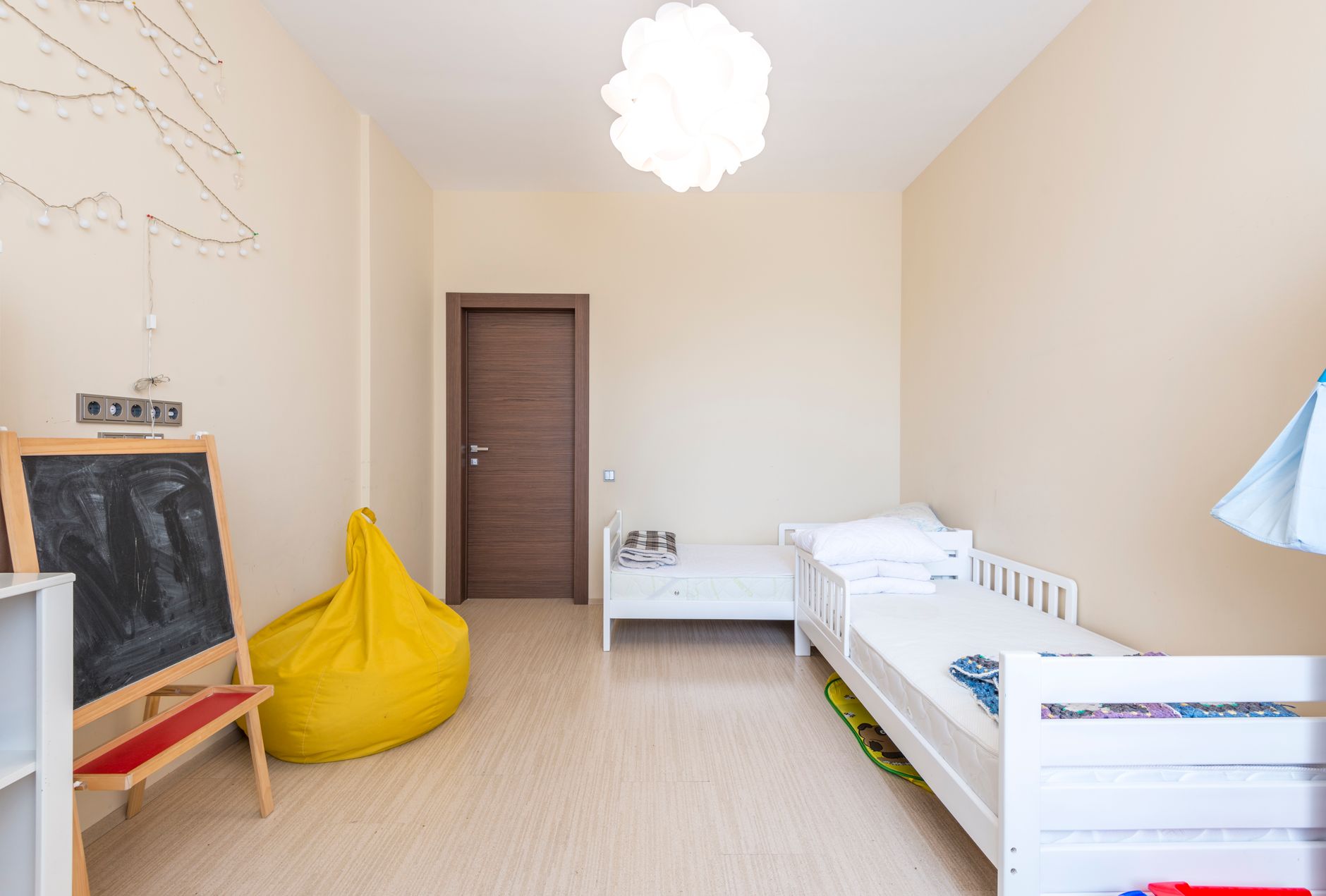
A kids' room presents a genuine styling challenge before photography day. It's rarely neutral, often loud, and packed with personal items that don't communicate value to a buyer. But strip it back too far and it loses the warmth that makes a family home feel real. The goal isn't to pretend children don't live there. It's to present a space that a buyer can picture their own family using.
Start with a serious declutter
Toys on the floor, sticker collections on walls, artwork taped to every surface: these details read as chaos in a photograph even when they feel cosy in person. Before styling anything, remove roughly two-thirds of what's visible. Pack toys into boxes, clear the floor completely, and take down any personal drawings or school photos. What remains should be things you've deliberately chosen to keep, not things that simply haven't been moved yet.
One common mistake is leaving a full bookshelf untouched. Pull out the broken-spined paperbacks and the odd plastic figurines wedged between books, and edit the shelf down to a curated selection. Three or four books stood upright with a small object beside them photograph far better than forty titles crammed in together. If the room has a decluttering plan for the broader property sale, the kids' room usually needs the most aggressive pass of any space in the house.
Neutralise without sterilising
Bright primary colours work brilliantly for a child. They don't work well for a property photo. If the walls are painted in a saturated red or electric blue, consider whether a fresh coat of paint in a softer tone is worth the investment before the shoot. A warm white, a soft grey, or a pale sage reads as versatile to buyers rather than specific to one child's taste.
Bedding is the quickest fix. Swap out character-printed duvets for something plain: white, ivory, or a gentle stripe. This single change often has the largest visual impact in the room. Add a folded throw across the foot of the bed in a complementary tone and the space immediately feels considered rather than functional. Keep any remaining colour accents deliberate: one cushion in a muted terracotta, a small rug in a warm neutral. Not four things competing at once.
What to keep in the frame
The best-performing kids' room photos retain just enough life to suggest the room's purpose without overwhelming the buyer. A few well-chosen items earn their place in the frame:
- One soft toy, placed on the bed or on a shelf (not on the floor)
- A small stack of books, spines facing forward on a shelf or bedside table
- A low basket or crate that holds a few toys out of sight but hints at storage
- A plant or a small vase of flowers if the room has natural light to support it
Wall art deserves particular attention. Remove anything with a child's name on it, both for privacy reasons and because personalised items narrow the buyer's ability to picture the room differently. Replace framed character posters with something simpler: a small print in a neutral palette, a framed botanical, or a black-and-white photograph. These don't need to be expensive. A plain print from a homewares store does the job.
Work with the room's size and light
Kids' rooms are often the smallest bedrooms in a property. That makes lighting and angle choices particularly important. If the room has a window, pull furniture away from it so natural light can reach as far into the space as possible. Turn on any ceiling lights and lamps before the photographer arrives, and make sure bulbs match in colour temperature. Warm and cool globes mixed in one room show up as inconsistent patches of colour in a photo.
The angle your photographer chooses can do a lot of the heavy lifting in a smaller space. A corner shot from a low-to-mid camera height tends to show the most floor area and give the room a sense of depth. Kitti Rivers Real Estate Photography uses this approach consistently in compact rooms to avoid that flat, box-like feel that makes small bedrooms look like cupboards. If you want to understand how these techniques apply to tight spaces more broadly, photographing small rooms covers the technical side in detail.
Built-in furniture and storage
If the room has built-in wardrobes, a loft bed with a desk beneath it, or any fitted shelving, photograph these features deliberately rather than letting them disappear into the background. Built-in storage is a genuine selling point for family buyers, and a well-shot wardrobe interior (doors open, shelves lightly styled) tells buyers the room can hold a real child's belongings without chaos.
Clear out the inside of any wardrobes that will be shot with doors open. One row of neatly hung clothes and a few items on the shelf is enough. Buyers aren't expecting the room to be empty. They're looking for evidence that the storage is functional and the space is genuinely usable.
Think about what the room says about the whole home
Buyers who are looking at family homes pay close attention to how a property handles the practical realities of living with children. A well-presented kids' room signals that the home has been looked after, that storage has been thought through, and that the floor plan works for real life. A cluttered, chaotic kids' room does the opposite: it raises doubt about the rest of the property even when the rest of the property is immaculate.
This is why the kids' room deserves the same level of care as the master bedroom or the living areas. The principles of home staging for photography apply just as directly here: edit the space down, make deliberate choices, and let the photographer do their job with a clean canvas.
The result is a room that reads as warm and liveable without reading as someone else's. That's exactly what a buyer needs to see.