
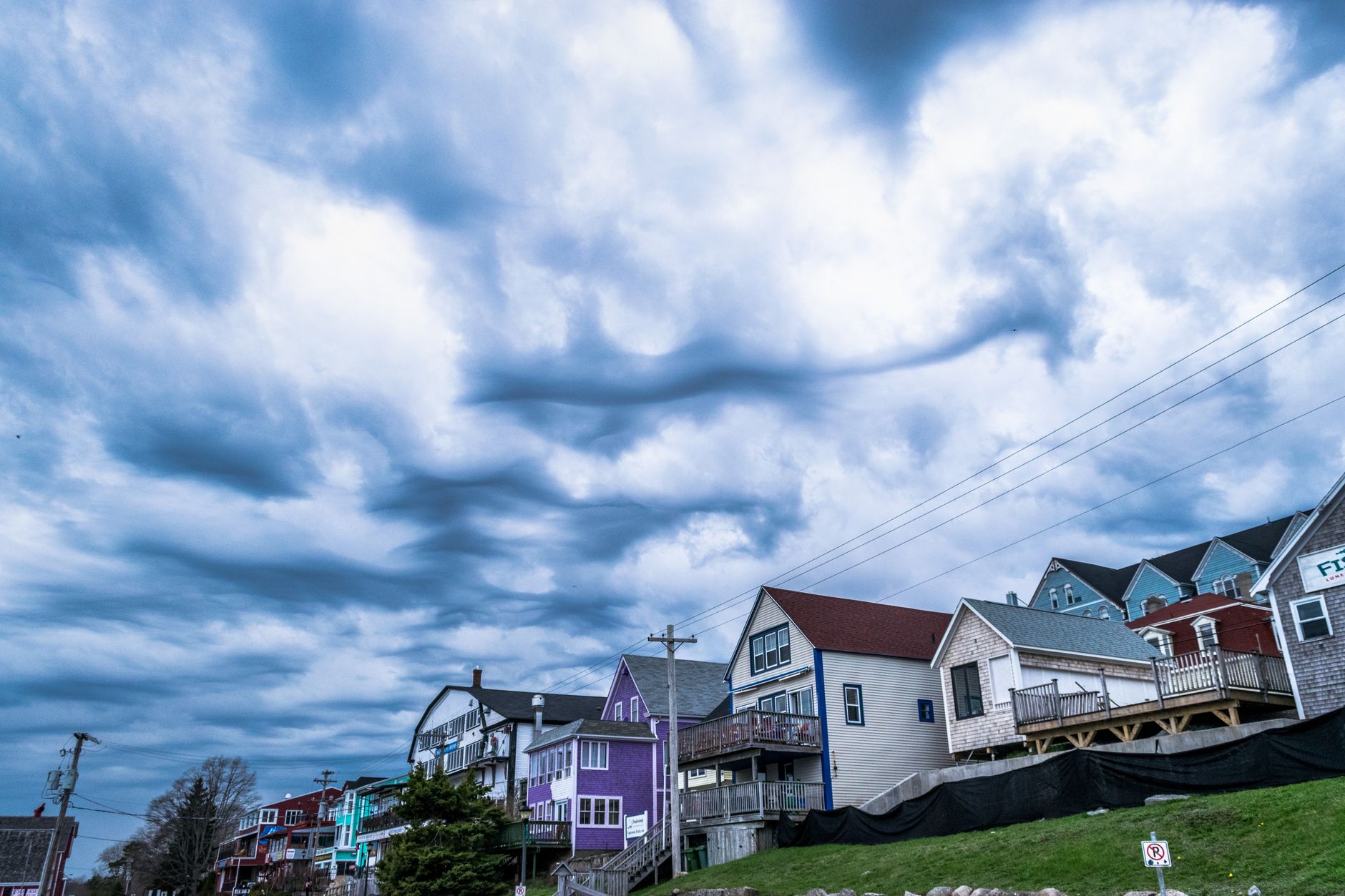
Overcast conditions get a bad reputation among property photographers, but the flat, diffused light a cloudy day produces is one of the most workable conditions you'll shoot in. Kitti Rivers Real Estate Photography books overcast sessions confidently, and for good reason: done right, grey-sky photography delivers balanced interiors, rich colour saturation, and exterior shots without the burnt-out highlights that harsh midday sun creates. The key is knowing where overcast light helps you and where you need to compensate.
Why overcast light is actually useful
An overcast sky acts like a giant softbox. The cloud cover scatters sunlight in every direction, eliminating the sharp, directional shadows that make interiors look patchy and exteriors look unflattering. Colours read more accurately. Grass holds its green. Brickwork shows texture without deep shadow. Window frames don't blow out.
For interiors, the benefit is real. Rooms with multiple windows no longer fight each other. You don't get one wall in bright sun and the opposite wall in near-darkness, which is the scenario that makes HDR processing messy. Even exposure across a room means less blending in post. That saves editing time and produces a cleaner result.
Overcast light is also forgiving of imperfect shoot timing. You're not racing the sun's position the way you would on a clear day.
Exterior shooting on overcast days
The main challenge outside is the sky itself. A featureless white sky reads as dead space in a photo, and buyers notice. There are two ways to deal with it.
First, reframe to minimise sky. Drop your shooting angle slightly so the roofline sits near the top third of the frame rather than leaving a slab of white above it. This works particularly well for single-storey homes. You include more foreground, which adds depth and grounds the composition.
Second, consider sky replacement in post-processing. Adobe Photoshop's sky replacement tool has matured considerably and handles rooflines cleanly in most cases. The replacement needs to look plausible for the region and season. A dramatic sunset sky dropped into a flat mid-morning shot reads as fake. A soft blue sky with light cloud convinces buyers without drawing attention to itself.
Avoid shooting directly into the remaining bright patch of sky if cloud cover is uneven. An inconsistently lit facade with one harsh highlight is harder to correct than a fully overcast shot.
Interior shooting on overcast days
Interiors benefit most. You'll find that ambient light exposure is more consistent room to room, which is exactly the condition where choosing between flash and ambient light becomes a genuine creative decision rather than a forced one. On overcast days, ambient-only or a subtle fill flash approach often produces the most natural results.
Expose for the room, not the windows. Window views will still be brighter than the interior, but the gap is far narrower than on a sunny day. In many rooms you can achieve an acceptable result in a single exposure without blending. Where the window is still too bright, a moderate bracketed exposure handles it cleanly.
Switch on every interior light source. Overcast ambient light alone tends to be cool in colour temperature. Warm artificial lighting from lamps and pendants balances the palette and stops rooms feeling clinical. Mixed lighting requires careful white balance work in post, but the warmth pays off in the final image.
Watch for colour casts from coloured walls or soft furnishings. Diffused light picks up reflected colour more readily than directional light does. A pale sage wall can throw a noticeable green cast across white surfaces nearby. Correct this in Lightroom using the HSL panel before doing any global adjustments.
Settings to adjust for overcast conditions
Your baseline camera settings shift slightly from a sunny-day shoot. ISO can be lifted modestly. On overcast exteriors, ISO 200 to 400 is reasonable without visible noise on modern sensors. Shutter speeds around 1/60s to 1/100s at f/8 give you enough depth of field to keep the entire facade sharp.
For interiors, f/7.1 or f/8 at ISO 400 to 800 works well when combining ambient with a single off-camera flash. Keep your flash power low enough that it reads as fill rather than key light. The goal is to lift shadow detail, not overpower the ambient source that's already doing the heavy lifting.
Shoot RAW. Overcast images often need a moderate exposure lift in post, and RAW files hold highlight and shadow detail that JPEG clips. The latitude in a RAW file from an overcast shot is considerable.
Post-processing overcast images
Overcast files typically need three targeted adjustments. Lift exposure by 0.3 to 0.7 stops as a starting point. Bring clarity down slightly for interiors to keep the mood warm rather than clinical. Add a touch of vibrance (not saturation) to recover the colour richness that flat light slightly mutes.
For exteriors, run sky replacement if the white sky dominates. Then match the light direction of the replacement sky to the light in your foreground. If the foreground shows soft, directionless light, pick a replacement with soft, scattered cloud rather than a high-contrast blue-sky shot that implies direct sun.
Avoid over-sharpening overcast images. The texture detail is already clear. Heavy sharpening on a flat-lit facade can introduce an artificial, HDR-style grittiness that buyers read as aggressive processing.
When overcast is the wrong call
Twilight photography doesn't benefit from overcast conditions. If the shoot brief includes a dusk exterior, a clear evening is essential. Cloud cover kills the warm sky gradient that makes twilight shots compelling and leaves you with a dark, featureless exterior. Reschedule twilight sessions when overcast conditions are forecast.
Similarly, homes with exceptional views lose something on a grey day. A property selling on the strength of a mountain or water panorama needs that view visible. In these cases, it's worth waiting for a clear day, or compositing a view shot taken on a different day into the interior window frames.
For most standard residential listings, though, overcast is a workable condition. Kitti Rivers Real Estate Photography treats grey days as an opportunity rather than a problem, and the resulting images reflect that approach.