
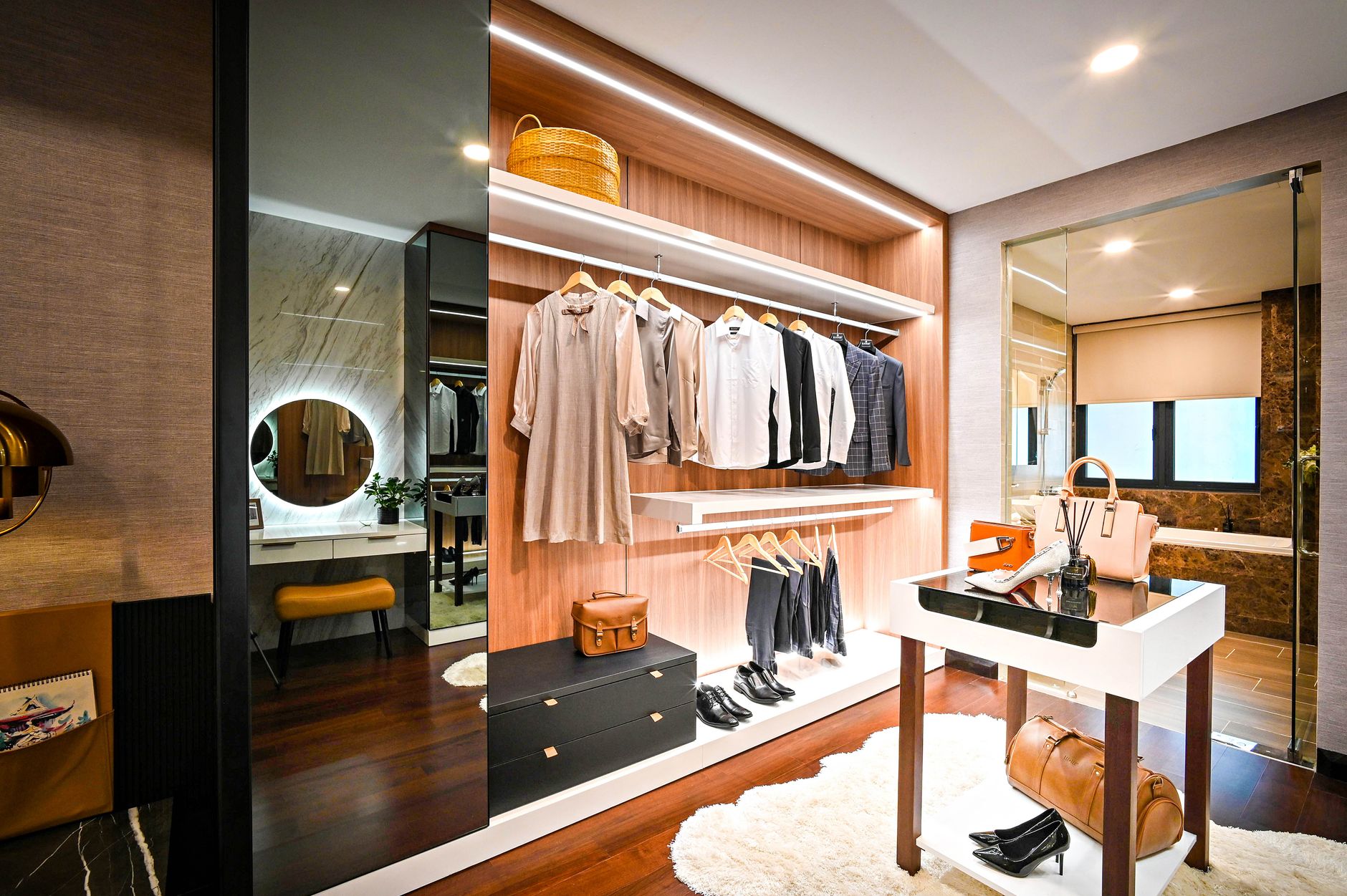
A walk-in wardrobe is one of the few features that can genuinely tip a buyer's decision. Buyers don't just glance at it. They step inside, they picture their clothes hanging there, and they remember it when they're deciding between two properties. Yet most sellers leave it exactly as it is: overstuffed, personal, and cluttered. That's a missed opportunity.
Styling a walk-in wardrobe for property photos isn't about pretending it's a boutique. It's about editing it down to a version of itself that reads as spacious, organised, and aspirational. The difference between a rushed shot and a considered one is often just an hour of deliberate work before the photographer arrives.
Start by removing at least half of what's in there
This is the single most important step, and most sellers stop short of it. A wardrobe that looks full in real life looks completely overwhelmed in photos. Wide-angle lenses compress depth, and hanging rails crammed with clothing read as chaotic rather than capacious.
Take out anything off-season and box it. Remove shoes from the floor entirely, or pare them back to 6 to 8 pairs maximum, evenly spaced. Clear the top shelves of anything that isn't decorative. The goal is visible shelf space. Empty shelf space in a wardrobe photograph reads as luxury, not emptiness.
Hang remaining clothes loosely, sorted by type and colour. Jackets together, then shirts, then lighter items. A gradient from dark to light along a hanging rail is a simple trick that makes any wardrobe look curated without much effort.
What to keep and what to hide
Keep a small number of deliberately chosen items visible. Three or four folded towels or spare linen on a shelf add texture without clutter. A single pair of shoes displayed on a shelf (not on the floor) adds a boutique quality. If there's a drawer unit, keep the top surface clear except for one or two items at most: a tray, a small vase, a dish for jewellery.
Hide everything personal. Medication, toiletries, sentimental items, photos, and anything with a name on it should come out before the photographer arrives. Buyers need to picture their own lives in the space. Personal items prevent that.
Handbags and accessories are worth their own section. If you have a dedicated hook or shelf for bags, keep two or three that are in good condition and place them deliberately. If they're just piled on a shelf, remove them completely. A single well-placed bag is a styling prop. A pile is just storage.
Lighting matters more than you'd expect
Walk-in wardrobes are almost always under-lit, and that's where most listing photos fall flat. The space looks dim, colours go flat, and the sense of depth disappears. A few practical things help significantly.
Turn every light on, including any LED strip lighting along rails or shelves. If the wardrobe relies entirely on a single ceiling downlight, consider temporarily adding a small portable LED panel on the floor facing upward to bounce light into the room. Check whether the photographer plans to use supplemental lighting. If not, ask. Kitti Rivers Real Estate Photography uses lighting approaches suited to the specific space, so it's worth discussing this during the booking.
If there's a window or a glass door, check how light is entering the space before the shoot begins. Direct sunlight creates harsh shadows across shelving. A sheer curtain or shooting on an overcast day can make a significant difference. For more on managing difficult interior light, the guide on how to market a property with no natural light covers techniques that apply directly to enclosed spaces like wardrobes.
The floor and the ceiling
Most sellers forget both of these surfaces. Both appear in a well-composed wardrobe photo, and both affect how the space reads.
The floor should be completely clear unless you're displaying a small number of shoes very deliberately. A clear floor doubles the perceived size of the space in photos. If the wardrobe has carpet, vacuum it immediately before the shoot. Vacuum marks are fine. Footprints are not.
The ceiling is relevant if there's track lighting or a pendant. Make sure bulbs are working. A dark corner caused by a dead globe is an easy fix that sellers regularly miss. If there are dust cobwebs visible near cornices, remove them. A photographer won't mention it, but the camera will find them.
How this connects to the master bedroom styling
A walk-in wardrobe rarely photographs in isolation. It's usually accessed through the master bedroom, and buyers experience them together. That means the styling has to feel consistent between the two spaces. If the bedroom reads as calm and edited and the wardrobe is chaotic, buyers register the disconnect even if they can't articulate it.
For a cohesive approach, style both rooms in the same session before the photographer arrives. The guide on how to style a master bedroom ensuite for property photos covers the adjacent spaces that buyers evaluate as a set, and the same principles around editing, lighting, and visual calm apply directly here.
Common mistakes to avoid
- Leaving visible laundry or dry-cleaning bags on hangers
- Keeping the floor covered with shoes, boxes, or bags
- Using mismatched hangers (replace with a single style before the shoot if possible)
- Leaving personal documents, jewellery, or medication visible
- Forgetting to turn on internal lighting before the photographer sets up
Matching hangers deserve a specific mention. It's a small detail that costs almost nothing and makes a disproportionate difference in photos. A rail of clothes on matching slim velvet hangers reads as considered and intentional. A mix of wire, plastic, and padded hangers reads as messy regardless of how the clothes are arranged. A pack of uniform hangers from any homewares store is a worthwhile buy before a shoot.
What great wardrobe photos actually communicate
When a walk-in wardrobe photographs well, it does something specific: it shifts from being a practical feature to being an emotional one. Buyers stop thinking about storage and start imagining a version of their daily routine that feels a little more refined. That emotional shift is what drives offers, not the square metre count.
The preparation takes roughly an hour. The result stays in the listing for the entire campaign. That's one of the better returns on time a seller can get before a shoot day.