
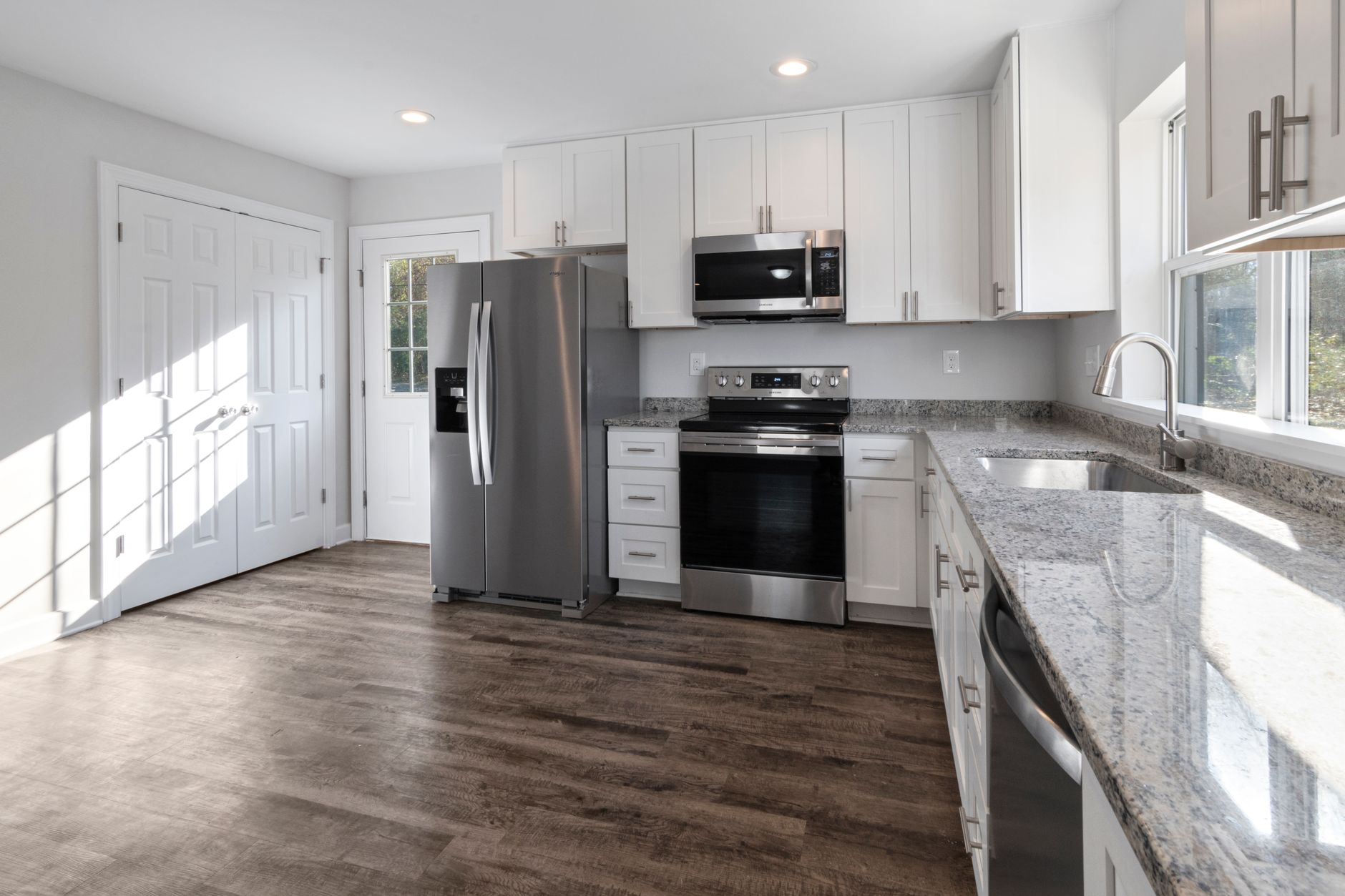
A renovated home is one of the easiest properties to oversell in a listing and one of the most commonly undersold. Agents and vendors spend months (sometimes years) on a renovation and then compress all that work into a line like "freshly renovated throughout." Buyers have read that phrase so many times it carries almost no information. A well-written listing description for a renovated property does something different: it names what was done, places it in context, and gives buyers a reason to walk through the door.
Start with the scope, not the outcome
Most renovation descriptions lead with adjectives. "Stunning," "immaculate," "beautifully presented." These tell the buyer how they're supposed to feel, which is the opposite of persuasive. Start instead with the scope of work: what was touched, what was replaced, what was structurally changed. Buyers are trying to build a mental picture of the property's condition. Give them the facts and let the adjectives arrive on their own.
A kitchen renovation, for example, is not a single thing. Stone benchtops, Smeg appliances, soft-close cabinetry and new plumbing are all distinct selling points. Each one answers a question a buyer might have. Write them out separately rather than grouping them under a catch-all phrase. Specificity signals quality in a way that broad claims simply don't.
Sequence the renovation in a way that flows
Buyers read a listing description in roughly the same order they'd walk through a property. Front to back, ground floor to upper floor, wet areas last. If your renovation touched multiple rooms, describe it in that order. Don't jump from bathroom to backyard to kitchen. A description that follows the natural flow of the home is easier to read and easier to remember.
This also helps you avoid repetition. When you write room by room, you're less likely to reach for the same phrases twice. "Fully tiled" in the bathroom means something different from "new tiling" in the laundry. Keeping the rooms in sequence forces you to be specific about each one.
If you're writing the description alongside professional photography, let the images and the copy reinforce each other. The listing description and photography work as a pair: the photos prove what the copy claims, and the copy gives buyers language to use when they talk about the property later.
Name the materials and the brands that matter
Engineered timber floors read differently from laminate. Dulux wash-and-wear paint reads differently from a generic "freshly painted." Buyers understand these distinctions and they know what they cost. If your renovation used quality materials, name them. This isn't brand-dropping for its own sake. It's evidence.
The same principle applies to structural or compliance work. A new roof, rewired electrics, or a re-plumbed bathroom are significant investments that buyers can't see in photos. Call them out in the description. A buyer who learns about a new HIA-compliant electrical upgrade in the body copy feels more confident than one who only discovers it in the contract documents.
Handle partial renovations honestly
Not every renovation is top to bottom. Many properties have a fully updated kitchen and bathrooms sitting inside an otherwise original home. That's a legitimate selling proposition, but it needs careful framing. Don't describe a partially renovated home as though it's been fully transformed. Buyers who arrive at an inspection expecting one thing and find another leave with distrust, not offers.
Instead, frame the renovation for what it is: the heavy-lift work is done. Buyers know that kitchens and bathrooms drive renovation costs. If yours are new and the rest of the home is original but well-maintained, say that plainly. "The kitchen and bathrooms were fully renovated in 2024; the rest of the home retains its original character with fresh paint throughout." That sentence is more credible, and credibility converts.
Connect the renovation to the buyer's life
Every renovation decision a vendor makes was motivated by something: more light, better flow, easier entertaining, room for a growing family. Those motivations are exactly what buyers are feeling too. A great listing description connects the renovation to a life the buyer can imagine living.
"The open-plan kitchen and living zone extends onto a north-facing deck, giving the home all-day light and a natural space for entertaining" is more useful than "open plan living." Both describe the same feature. One describes what it does for the buyer. This is where a strong listing headline and a well-constructed description reinforce each other: the headline earns the click, the description earns the inspection.
Watch for phrases that buyers have learned to distrust
There's a short list of phrases that appear in so many listings that buyers now read them as red flags rather than selling points. "Nothing to do but move in" suggests the vendor is defensive about condition. "Motivated seller" suggests desperation. "Priced to sell" tells buyers nothing about the property. "Renovator's dream" when applied to a renovated home is just confusing.
Cut these on principle. Read the description back and ask whether each sentence is carrying real information or filling space. If it's filling space, cut it. A tight 200-word description full of facts will outperform a padded 400-word one that circles the same claims.
Don't forget the things photos can't show
Professional photography captures light, proportion and finish. It doesn't capture council rates, catchment zones, noise levels, or the fact that the renovation included new insulation in the ceiling. The listing description is the right place for these details. Think of it as the answer to every question a buyer might ask before they pick up the phone, and write it accordingly.
A renovated home with a well-written description and strong photography gives buyers confidence at every step. The photos earn the inspection. The description earns the offer.